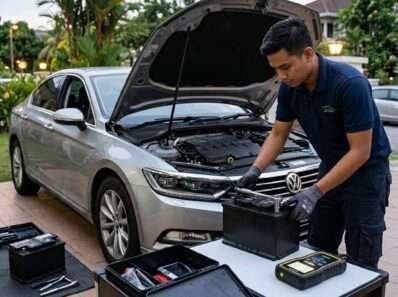
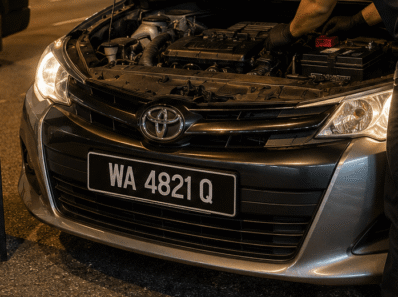
Experiencing a sudden click-start failure when turning your ignition key in the middle of a rainy evening in Subang Jaya is incredibly frustrating. Arranging a swift, professional toyota car battery replacement ensures you avoid prolonged roadside delays and protects your vehicle’s sensitive electronic control units (ECU) from electrical spikes. Because modern sedans and SUVs rely heavily on onboard computing systems, choosing the correct battery specifications is critical to avoid system errors.
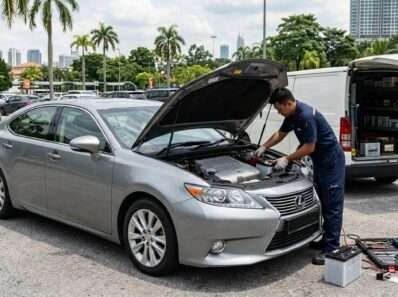
A battery problem does not always happen while the car is sitting safely at home. It can happen after work, while you are shopping or when you are about to leave for an appointment. This is why a mobile toyota car battery replacement service can be useful, especially when the vehicle cannot be started easily.
Instead of immediately arranging for the car to be moved, the battery can first be checked at the vehicle’s location. This gives the technician a chance to see whether the battery is actually causing the starting problem before replacing anything.
Matching Battery Technology to Your Specific Toyota Model
Installing a generic, undersized battery into a modern vehicle can trigger immediate alternations in charging efficiency and fuel economy. Standard models like the Vios or older Corolla Altis variants typically require a conventional maintenance-free NS40ZL or NS60L calcium battery. However, newer models equipped with Toyota’s Smart Stop technology (Idling Stop System), such as the modern Yaris or Veloz, strictly demand an Enhanced Flooded Battery (EFB) M-42 or Q-85 series. Fitting a standard battery into an EFB-reliant system causes the battery to degrade rapidly within a few months due to the high cyclical charge demands of automatic engine restarts.
Toyota has many models on Malaysian roads, and the battery used in one model may not necessarily be suitable for another. Even cars with the same model name can have different requirements depending on the year and vehicle specification.
Before requesting a replacement, it helps to provide the technician with your Toyota model, year and current battery details if you can see them. This makes it easier to check which replacement is suitable instead of choosing a battery based only on its physical size.
Proper Terminal Cleansing and Memory Saver Calibration
The physical replacement process requires precise technical execution to preserve your vehicle’s electronic memory and idling calibration profiles. Before disconnecting the old terminals, an experienced technician must hook up an OBD-II memory saver device to maintain a continuous 12-volt current to the vehicle’s computer. This step prevents your digital clock, radio settings, and throttle body sensor data from resetting completely. If you are dealing with a more complex or rare performance vehicle alongside your daily commuter, seeking specialized lamborghini battery replacement standards ensures that even the most sensitive European electrical networks are handled safely.
The battery area itself should also be looked at during replacement. Over time, dirt or corrosion can sometimes build up around the terminals. If anything unusual is found, it should be dealt with properly before the new battery is connected.
Once the replacement is complete, it is also worth checking that the battery is sitting securely in its tray and that the connections are properly fitted. These may sound like small details, but they are still part of doing the replacement properly.
Verifying Cold Cranking Amps and Alternator Output Baseline
Never purchase a replacement unit without checking its structural label metrics, specifically the Cold Cranking Amps (CCA) and Reserve Capacity (RC). A reliable replacement for a tropical climate like Malaysia should carry a minimum of 360 to 420 CCA to handle frequent short-trip heat cycles without internal plate buckling. Once the new unit is clamped securely into the tray, the technician must use a digital battery analyzer to test the alternator’s charging voltage. The alternator output must consistently read between 13.8 and 14.4 volts under full load—with the air conditioning and headlamps turned on—to guarantee long-term battery health.
If a relatively new battery keeps going flat, simply replacing it again may not solve the actual problem. There could be another reason the battery is losing charge, which is why checking the vehicle’s charging system can be useful.
This is especially worth considering when the same starting problem has happened several times. Finding out why the battery keeps losing power can prevent you from repeatedly replacing batteries without addressing the underlying issue.
Conclusion
Selecting a vehicle-specific battery tech baseline and verifying alternator health saves you from repeating the replacement process prematurely. Trusting certified, on-site mobile mechanics ensures your vehicle’s computer systems remain fully operational without requiring an expensive trip to the dealership. Are you currently stranded with a dead engine or a clicking starter motor somewhere in Kuala Lumpur? Reach out to our mobile dispatch crew via our emergency service hotline to get a premium battery delivered and fitted to your location within 30 minutes.