
How long does a car battery last in Malaysia? There is no fixed lifespan, as actual battery life depends on the battery type, vehicle condition, driving habits, temperature and charging system performance.
Some batteries may provide several years of reliable service, while others may fail much earlier. The actual lifespan depends on the battery technology, vehicle charging system, driving conditions, electrical load, temperature, maintenance and how frequently the vehicle is used.
This is particularly important in Malaysia, where year-round high temperatures, heavy traffic congestion and frequent short-distance driving can place additional stress on automotive batteries.
Instead of replacing a battery based on age alone, its actual condition should be determined through proper battery and charging system testing.
Why Is There No Fixed Lifespan For A Car Battery?
Car batteries do not simply expire after a specific number of months or years.
Two identical batteries installed in the same vehicle model can have very different service lives depending on how the vehicles are driven and maintained.
Battery lifespan can be affected by:
- Battery technology
- Vehicle charging system
- Ambient and engine bay temperature
- Driving frequency
- Short-distance driving
- Traffic conditions
- Number of engine starts
- Electrical equipment and accessories
- Depth of battery discharge
- Long periods of vehicle inactivity
- Alternator performance
- Battery management system
- Correct battery specification and installation
For this reason, battery age should be treated as only one factor when evaluating battery condition.
How Does Malaysia’s Hot Weather Affect Car Batteries?
Heat is one of the major factors affecting lead-acid battery ageing.
Malaysia’s tropical climate means vehicles are regularly exposed to high ambient temperatures throughout the year. Temperatures inside the engine compartment can become considerably higher, particularly after prolonged driving or when vehicles are stationary in traffic.
High temperatures accelerate electrochemical reactions inside a lead-acid battery and can increase internal ageing.
Over time, this may reduce the battery’s ability to store energy and provide sufficient starting power.
This is one reason a battery that performs well initially may gradually lose capacity even though the vehicle can still start normally.
How Does Traffic Congestion Affect Battery Life?
Heavy traffic is part of everyday driving for many motorists in Kuala Lumpur and Klang Valley.
During stop-and-go traffic, the vehicle may spend considerable time idling while electrical systems continue operating.
These may include:
- Air conditioning
- Cooling fans
- Headlights
- Infotainment systems
- USB chargers
- Dashcams
- Safety systems
- Electronic control modules
- Start-Stop systems
Modern vehicles have significantly greater electrical requirements than older vehicles.
When driving conditions repeatedly combine high electrical demand with low-speed journeys and frequent engine starts, the battery and charging system have to work considerably harder.
Why Are Short-Distance Trips Hard On Car Batteries?
Starting an engine requires a large amount of electrical power for a short period.
Once the engine starts, the alternator needs time to replenish the energy removed from the battery.
If a vehicle is repeatedly driven only for short distances, there may not always be sufficient driving time to restore the battery to a healthy state of charge.
This can become more significant when the vehicle also operates:
- Air conditioning
- Headlights
- Dashcams
- Audio systems
- Phone chargers
- Electronic accessories
Repeated undercharging can gradually affect battery performance.
A vehicle that is driven every day is therefore not automatically a vehicle with a fully charged battery.
Does Start-Stop Driving Affect Battery Life?
Start-Stop vehicles place significantly greater cycling demands on their batteries than conventional vehicles.
Every time the engine automatically switches off and restarts, the battery must support another starting cycle while continuing to supply power to the vehicle’s electrical systems.
This is why Start-Stop vehicles normally require specialised battery technologies such as:
EFB – Enhanced Flooded Battery
EFB batteries are designed to provide greater cycling durability than conventional flooded starter batteries and are commonly used in vehicles equipped with basic Start-Stop systems.
AGM – Absorbent Glass Mat
AGM batteries provide greater cycling capability, strong charge acceptance and high electrical performance.
They are commonly used in vehicles equipped with advanced Start-Stop systems, regenerative braking, sophisticated electronics or high electrical loads.
The correct battery technology should always be maintained when replacing a Start-Stop battery.
Installing an unsuitable battery may result in reduced battery performance, shortened service life or improper Start-Stop system operation.
AGM, EFB And Conventional Batteries Do Not Age The Same Way
Different battery technologies are designed for different operating requirements.
A conventional starter battery is primarily designed to provide the high current required to start an engine.
EFB batteries are engineered to tolerate significantly more charge and discharge cycles.
AGM batteries provide even greater cycling capability and are designed for vehicles with demanding electrical systems.
However, this does not mean every AGM battery will automatically last a specific number of years.
Battery technology is only one part of the equation.
Vehicle condition, charging strategy, temperature, driving habits and electrical demand still have a major influence on actual battery service life.
Can A Car Battery Fail Earlier Than Expected?
Yes.
A relatively young battery can fail prematurely if it is exposed to unfavourable operating conditions.
Possible causes include:
- Persistent undercharging
- Faulty alternator
- Charging system problems
- Parasitic electrical drain
- Vehicle parked for long periods
- Frequent deep discharge
- Incorrect battery specification
- Excessive heat
- High electrical demand
- Loose or corroded battery terminals
- Battery management system issues
This is why replacing a battery without checking the vehicle’s charging system may not always solve repeated battery problems.
If several batteries have failed prematurely in the same vehicle, further diagnosis is recommended.
Signs Your Car Battery May Be Getting Weak
A weak battery does not always fail immediately.
There may be warning signs before the vehicle becomes completely unable to start.
Common symptoms include:
- Engine cranks slower than usual
- Clicking sound when attempting to start
- Vehicle requires a jump start
- Start-Stop system stops operating
- Interior or exterior lights become weak during starting
- Vehicle struggles to start after being parked
- Battery repeatedly becomes discharged
- Electrical systems behave abnormally during starting
However, symptoms alone cannot confirm battery condition.
Proper testing is recommended before deciding whether the battery requires replacement.
Does A Battery Warning Light Mean The Battery Is Bad?
Not necessarily.
The battery warning light on the dashboard is generally related to the vehicle’s charging system rather than simply indicating that the battery needs replacement.
Possible causes can include:
- Alternator failure
- Charging system fault
- Wiring problem
- Drive belt problem
- Battery connection issue
- Other electrical system faults
If the battery warning light remains illuminated while the engine is running, the charging system should be inspected.
Replacing the battery alone may not solve the problem.
How Do You Know When A Car Battery Needs Replacement?
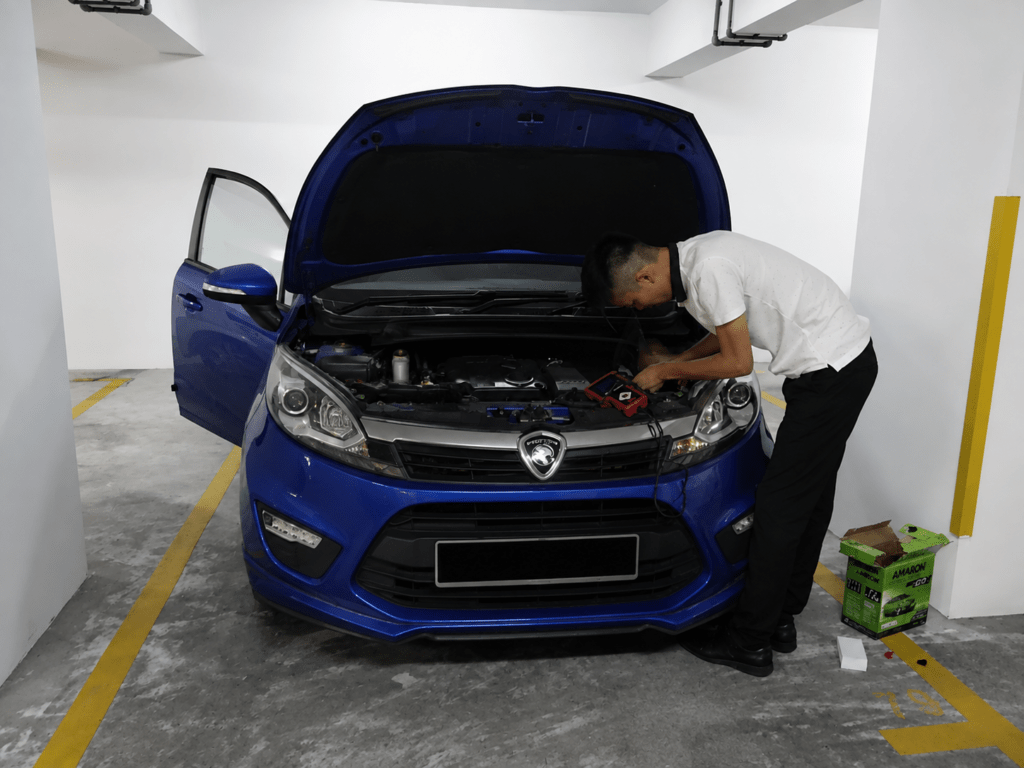
The best way to determine battery condition is through proper testing.
A professional battery assessment may include:
- Battery voltage measurement
- State of Charge assessment
- Battery health test
- Cold Cranking Amps (CCA) test
- Starting system test
- Alternator charging test
- Charging voltage inspection
- Battery terminal inspection
Testing provides much more useful information than battery age alone.
A battery may be several years old and still perform correctly, while another battery may become weak much earlier due to operating conditions or vehicle problems.
Should You Replace A Battery Just Because It Is Old?
Not necessarily.
Battery age is useful information, but it should not be the only reason for replacement.
If an older battery still passes the appropriate tests and the vehicle starts reliably, immediate replacement may not always be necessary.
However, older batteries deserve closer attention because battery performance naturally deteriorates with ageing.
Preventive testing becomes increasingly valuable as a battery gets older, particularly before:
- Long-distance travel
- Holiday journeys
- Airport trips
- Extended periods of vehicle parking
- Outstation travel
A quick battery test can identify deterioration before it turns into an inconvenient roadside breakdown.
Can Regular Battery Testing Prevent A Breakdown?
Testing cannot guarantee that a battery will never fail unexpectedly, but it can identify many weak or deteriorating batteries before complete failure occurs.
Regular testing is particularly useful for vehicles that:
- Are frequently driven in heavy traffic
- Make mostly short journeys
- Have high electrical loads
- Use Start-Stop technology
- Are parked for extended periods
- Have previously experienced battery problems
Battery testing should ideally be combined with charging system inspection.
This helps determine whether the battery itself is weak or whether another vehicle component is contributing to the problem.
How Can You Help Your Car Battery Last Longer?
Although battery ageing cannot be completely prevented, good vehicle usage and maintenance can help reduce unnecessary stress.
Recommended practices include:
- Use the correct battery specification
- Drive the vehicle regularly
- Avoid unnecessary deep discharge
- Do not leave electrical accessories operating when the engine is off
- Keep battery terminals clean and secure
- Maintain the vehicle’s charging system
- Investigate repeated battery discharge
- Use an appropriate battery charger during extended periods of inactivity
- Test the battery periodically
- Replace AGM with AGM where specified by the vehicle manufacturer
For vehicles equipped with battery management systems, battery registration, adaptation or coding may also be required after replacement.
Frequently Asked Questions
How many years should a car battery last in Malaysia?
There is no fixed number of years that applies to every car battery in Malaysia.
Actual service life depends on battery technology, temperature, vehicle condition, charging performance, electrical demand and driving habits.
The condition of the battery should therefore be determined through testing rather than age alone.
Does hot weather shorten car battery life?
Yes.
High temperatures accelerate electrochemical ageing inside lead-acid batteries and can contribute to reduced battery performance over time.
Does traffic congestion damage a car battery?
Heavy traffic can contribute to demanding battery operating conditions, particularly when combined with high electrical loads, frequent Start-Stop operation and short-distance driving.
Why does my battery keep dying even though I drive every day?
Daily driving does not necessarily mean the battery receives a full charge.
Frequent short journeys, electrical loads, charging system problems or parasitic drain can result in an insufficient state of charge even when the vehicle is used regularly.
Is AGM always better than EFB?
Not necessarily.
The correct battery depends on the vehicle manufacturer’s requirements and electrical system.
AGM offers greater cycling capability and is designed for more demanding applications, while EFB is suitable for many vehicles with basic Start-Stop systems.
Can I replace an AGM battery with an EFB battery?
If the vehicle was originally designed for AGM, replacing it with EFB is generally not recommended.
The replacement battery should meet the technology and specifications required by the vehicle manufacturer.
Can I replace an EFB battery with AGM?
An AGM upgrade may be possible for some applications, particularly where the vehicle has demanding electrical requirements.
However, compatibility with the vehicle’s charging system and battery management system should be verified before changing battery technology.
Can a car battery suddenly fail without warning?
Yes.
Some batteries deteriorate gradually and show warning symptoms, while others may appear to operate normally before suddenly losing sufficient starting capability.
This is why battery testing is useful, especially as the battery ages.
Should I change my battery before a long-distance trip?
Not simply because of its age.
Have the battery and charging system tested before the journey. If testing indicates that the battery is weak or deteriorating, preventive replacement may help avoid an unexpected breakdown.
Need Professional Car Battery Testing Or Replacement?
Marcus Battery Delivery provides professional on-site car battery testing and replacement services throughout Klang Valley.
We supply batteries for conventional, Start-Stop and high electrical demand vehicles, including:
- SMF Batteries
- EFB Batteries
- AGM Batteries
- Auxiliary Batteries
- Selected Lithium Automotive Batteries
Battery compatibility is verified according to the vehicle application before replacement.
Selected modern vehicles may also require battery registration, adaptation or coding after installation.
For Battery Assistance, Send Us:
- Vehicle Make & Model
- Manufacturing Year
- Current Battery Photo
- Vehicle Location
We can then check the appropriate battery specification for your vehicle.
Call / Emergency Battery Service: 016-3224319
WhatsApp: +6016-3224319
Website: https://24hourscarbattery.com.my